Verification clauses, read 26 August 2026
Why matching BitStarz on identity checks means publishing nothing
Forty-nine verification clauses were read across a hundred operators. Five state a sum, and three of those five state the same 2,500 EUR in an identically numbered clause, which leaves three independent figures in the whole pool. Eleven of the twelve rows here match BitStarz by saying nothing.
Every figure on this site divides by something. Territory overlap divides by the 74 countries BitStarz names. The verification check has no denominator of that kind, and the reason is that the field is almost entirely empty.
What was read, and how much of it carried a number
Verification clauses have been opened at 49 of the hundred operators in the library, all on 26 August 2026. Every one of the 49 leaves the decision with the operator: the right to request documents, at its discretion, at a moment of its choosing.
Twenty-seven of the 49 carry a clause number. Twenty-two do not, which means the right is described in prose a reader cannot cite by address.
Five of the 49 attach an amount.
That last figure is the one everything below rests on. Five in a hundred, and the five are not five independent decisions.
Three figures wearing five badges
Bitcasino.io, Sportsbet.io and Livecasino.io each state 2,500 EUR, each at a clause numbered 6.6. Two of the three also print the same permit number, OGL/2023/111/0069, held by Moon Technologies B.V.
One paragraph, drafted once, counted three times by anybody tallying disclosures.
The remaining two stand on their own. Rocketpot prints 2,500 USD at clause 11.4, and Empire.io prints 2,000 USDT at clause 5.4. So a reader who wants to know what a normal verification threshold looks like in this trade is working from three independent numbers, in three currencies, and they cluster tightly enough — 2,000 to 2,500 — that the cluster is probably a convention rather than a coincidence.
Three data points cannot support a comparison, and this site does not attempt one.
The paradox in the middle of the measure
Similarity here is measured against one operator, and the verification check is worth 10 of the 100 points. It asks whether a row's posture matches the reference posture: a described discretion, with no amount attached.
BitStarz publishes no amount. So the check pays out for publishing no amount.
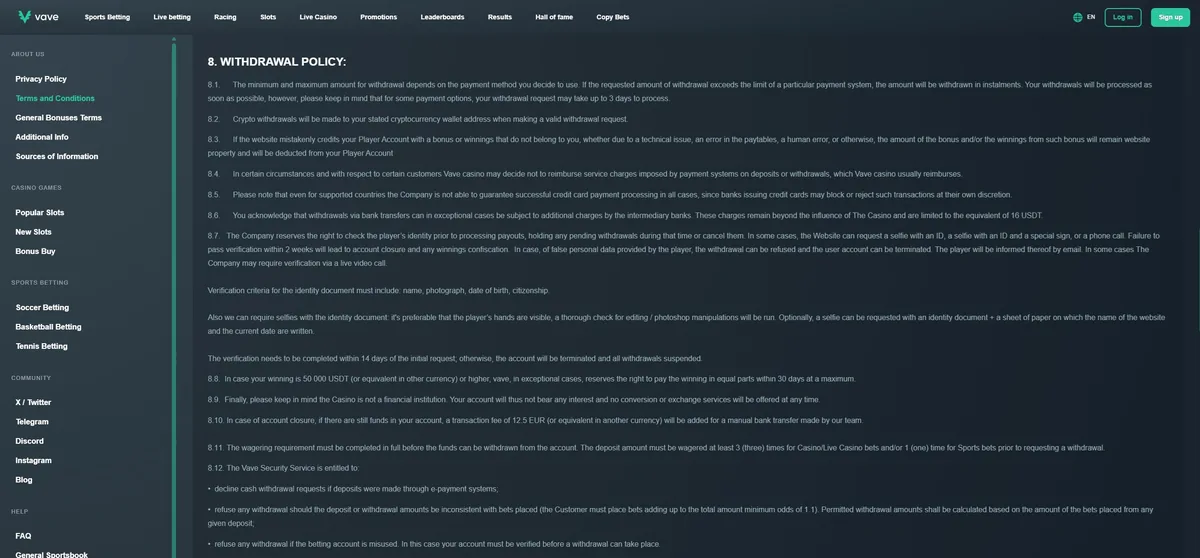
Eleven of the twelve rows on this site collect it. Seven of them at least carry a clause number — Bets.io at 5, Mirax at 7, Vave at 8.7, Metaspins at 9.7, Oshi and PlayAmo at 12, Slotum at 13 — and four describe the same discretion with no number recorded: BitStarz itself, alongside Bitkingz, BitDreams and CryptoLeo. The twelfth row, 7Bit, has no verification clause read at all and carries nothing to compare rather than a match.
A check that eleven rows out of twelve pass is a weak instrument, and its weight says so. Ten points, against the 30 that territory overlap carries, because one compares a long list to a long list and the other records that two documents are silent in the same way.
Rewarding a match here is defensible only while the reference operator is the thing being matched. It would be indefensible as a claim that silence is a virtue, and no page on this site makes that claim.
One row says a threshold exists and withholds it
Metaspins is worth separating from the other ten, because its clause 9.7 does something the rest do not: it states that verification becomes required once play reaches a threshold, and then declines to say what the threshold is.
That is a third state, sitting between a printed figure and an open discretion. The operator has confirmed a number exists inside its own procedures and has kept it off the page. The ceiling clause, 12.5, follows the same pattern: it has a clause number and no amount.
For the measure, that row still matches BitStarz, because the effect on a reader is identical: no figure to plan against. For a reader, the two are not identical at all, and the difference is printed here rather than flattened into the score.
What the clock adds, where there is one
Three of the twelve rows attach a period to a document request, and all three run against the customer rather than the operator.
Bets.io allows 30 calendar days under clause 5. Oshi allows 40 days under clause 12, and adds that winnings may be confiscated if the information does not arrive inside it. Vave allows 14 days under clause 8.7. The other nine documents set no period on either side, which means a request stays open for as long as it stays open.
Not one document read for this site sets a period inside which the operator must finish looking at what it asked for.
Where the money question is answered instead
The verification field is the emptiest column on this site, and its neighbour is not. Seven of the twelve rows print a withdrawal ceiling with a clause number attached, and that column can be turned into a timetable for any balance a reader cares to name.
Which is the practical advice this article ends on: for planning purposes the ceiling is the number to read, because it exists, and the threshold is the number to stop looking for, because in 95 documents out of a hundred it is not there. The seven ceilings, with their four different windows and the conspicuous blank beside them, are on the withdrawal limits.
The ten closest rows, with the count each was measured on, are on the ten alternatives.